


Working through the Festive Season? Well, you have Some Opportunities!

Working through the festive season when everyone around you seems to be enjoying doesn’t have to give you the ‘fear of missing out’. Read on.

Working through the festive season?

Having the ‘fear of missing out’ on the festivities, or what they call FOMO?

While some of us are enjoying the festive season with gatherings with our near and dear ones, seeking blessings and indulging in delicacies of all flavours, some of us don’t have this opportunity.

But there’s a different set of opportunities for this latter lot. Read on.

The Opportunity to Enjoy the Routine:

Festivities- organising events, redecorating homes and offices can be tiring. And the thing is, work commitments can pile up around such times. There’s just so much to juggle- office, home, events at the office and events at home- that it can become difficult to manage everything.

So, the ones who aren’t busy with the festivities have an opportunity to enjoy their own calm routine. There’s a quiet beauty in the mundane but productive daily life that tires you just about enough to fall asleep peacefully at night.  

The Opportunity to Use the Festive Spirit Differently:

There’s a certain festivity in the air that can make many feel alive. Whether you are in India with people around celebrating the Diwali nights, or somewhere else on the globe, fresh out of celebrating Oktoberfest or Halloween, or your part of the world is on its way to celebrate Thanksgiving or Christmas, there’s just a certain momentum around.

Now is a great time to channelise this lively momentum into your work. Old ‘new’ initiatives lying pending somewhere in a file at the back, finishing up a long due task, or who knows, even planning for a new year resolution! If one must work through the festive season, why not show the pending tasks some dazzling lighting too!

The Opportunity for Gratitude:

Now is a great time with longer evenings and shorter days to be grateful about what we already have. Longer evenings, dark and cool call us to light our own warmth into it, and isn’t gratitude the best kind of warmth? Gratitude for the work that gives us the means to live well and dream more, gratitude for the learning each day brings, gratitude for our abilities and competencies. Once we start thinking about it, the list of small and big things to be grateful about it is endless.

The last stretch of the year brings ample opportunities for all of us. Sometimes, the opportunity to rest, rejuvenate, celebrate and indulge. And sometimes, the opportunity to plan, implement and being grateful.
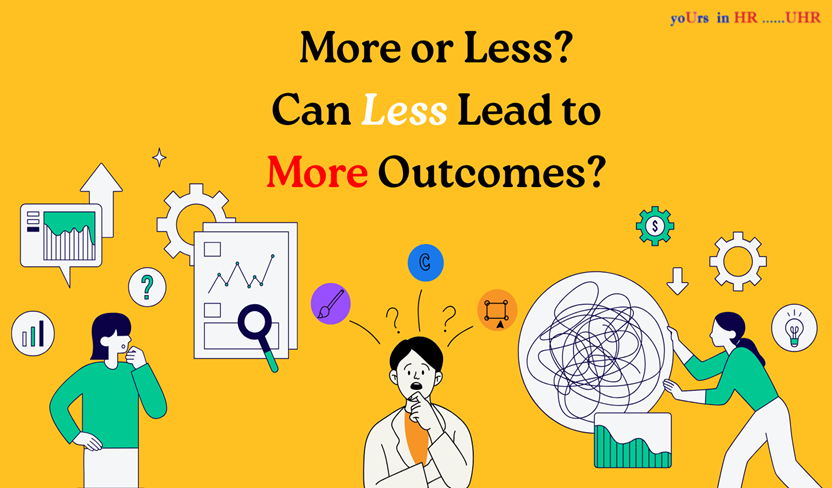
More or Less? Can Less Lead to More Outcomes?

‘More’ doesn’t always equal to ‘better’. Limits and limitations, that is, ‘less’ is equally important (if not more) for productivity.

When we think about generating ideas, starting and running a successful company or just about any small or big venture we think about abundance. We think of ‘more’. We think limitlessness.

We think more the number of resources, the better everything will be. More work hours. More ideas. More plans. More objectives.

Not just about tasks and plans, but even in day to day to interactions- ‘more’ is considered positive.

More agreement- better results. More encouragement- more work done. More power. More control. More responsibility. More people. More anything? Better. We think anything limitless is great.

But what if we told you that sometimes, less is better? Or in other words, rather than a free-flow of more ideas, more resources, more encouragement, more people sometimes it’s the ‘less’ that make things better? That sometimes setting limits, a cap of some kind is the way to making something more successful?

 The principle of setting limits or imposing limitations for benefit is actually used in everything around us, right from music to sport. Each genre of music has its limits of acceptable melodies, pitches, instrumentation. Magic happens within these limits. Each sport has its rules- be it the number of overs in a cricket, to the literal ‘boundaries’. It is these rules and boundaries that make a sport enjoyable. What’s more, economics operates on this principle too: companies cannot offer limitlessly increased or decreased prices without leading to issues in the whole market.

Not just in music, sport and economics but in any enterprise, it’s the ‘less’ that produces better results.

Think of limited resources: A company with limited capital will find ways to make the best use of that capital after thinking things through. A company with excessive capital may end up spending it on ventures that may or may have been carefully thought out.

A city that has limited tourism spots will maintain that small number of tourism spots really well. A city with more tourism spots may maintain only a few well-known ones even if they have ample resources.

Think of limits in idea generation: A whole list of ideas will likely lead to chaos with no proper direction. There will be no room for trial and error since the time will be spent in trying one idea after another as quickly as possible to arrive at the ‘big’ successful idea. But just two or three limited ideas that seem realistic will lead to a more concrete plan, with enough room for trial and error for each idea.

You know how they say, that too many chefs spoil the dish.  In some cases, too many choices! A candy-making company with four or five flavours was doing very well. They thought ‘why not add more flavours?’ going by the conventional understanding of ‘more is more’. They announced ten more flavours. All over the shops, the company now had close to twenty flavours.  But contrary to what they had thought, more flavours did not lead to more sales or more popularity. In fact, the sales of that candy brand had gone down!

A survey was conducted which found out that the ‘more’ number of flavours had confused their customers. With so many flavours to choose from, the customers were overwhelmed and ended up not buying any candy at all. Naturally, the company decided to withdraw the more flavours and of course, the sales increased again.

When we start thinking about limits this way, we realise they are everywhere and they push us towards producing better work. We work only a limited number of hours a day to prevent burnout. Limitless working hours do not lead to more output. Offices hire only a limited number of people. Having more people doesn’t necessarily mean a job well done. Each one of us has only a limited number of responsibilities attached to our job description even if we might be capable of doing more.  It is not ‘more and more’ but ‘less’ that help us remain productive, focused and successful. Less is actually more!