
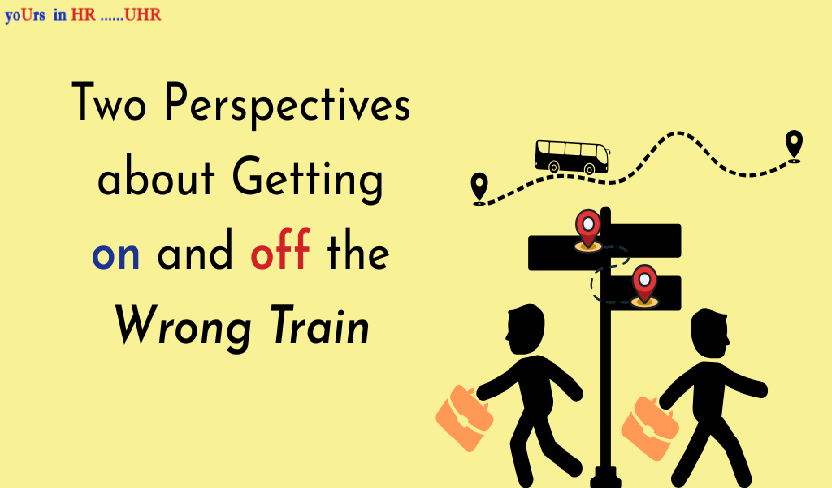
Life rarely goes as planned. Maybe you didn’t plan on the having the job you currently have, even five years ago. Sometimes, we chase after opportunities and sometimes, we are made to create opportunities for ourselves. We decide on one thing and another thing happens. There are two perspectives to these ideas about change (of life and plans of life for us) and growth.
The Cost of Change:
There’s a well-known Japanese proverb that goes:
“If you get on the wrong train, get off at the nearest station. The longer it takes you to get off, the more expensive the return trip will be.”
This can be applied to so many scenarios of life:
-Feel stuck in a job you don’t like? Quit before your mind gives in to the habit of comfortable misery. Get off the next station.
-Feel stuck on an idea you know doesn’t seem to be working out? Stop and check if you should put it on the side for now, quit or course correct. Decide the ‘station’ you want to get off and do that before the train rams into your sense of competence.
-If a project needs you to test something on a user, test on one user, in a controlled environment, so in case there’s a flaw, it doesn’t reach thousand users later. Decide if it works and make the required changes as early as you can. The more you stall, the more expensive the return ticket becomes. As the writer Steve Krug puts it, ‘the cost of change grows over time.’
The Suprises of a Journey:
On the other side of this coin about ‘getting off’ from the ‘wrong train’, there are countless writers and philosophers from across the world that remind us how it is the journey that is more important than the destination. One may get on the wrong train, one may not reach their originally planned destination. But they still get to take in new, undiscovered scenery. The ‘wrong’ train may eventually make us find new a destination we didn’t even know we needed.
This too can be applied to many scenarios in life:
-Stuck with a job which you didn’t plan on having? Might as well learn something about it now and try your best to do it well, with your full presence. We may know people professionally who didn’t plan on getting in a career they are in right now and somehow, managed to be at the top of that career they ‘originally’ hadn’t thought of choosing.
-Your initial idea has turned all topsy-turvy and you don’t know what to do with it now? Maybe there is a new direction your idea is meant to go in.
-Testing on a thousand users led to a different outcome than anticipated? Maybe think if the users can still benefit from this ‘new’ outcome.
Getting on a wrong train may either lead you away from your planned destination, or it may lead you to a destination you were more suitable to go in. Our decision then lies not in quitting, or staying but deciding the cost of staying on the ‘wrong’ train. And both decisions can be sensible ones depending on our situation. Some questions we may ask ourselves are:
- Is the cost of change likely to make your life miserable?
- What will you lose if you stay on the wrong train?
- Is there something you may gain if you stay on the wrong train?
These are the answers we need, which may help us decide whether to get off at the next station or enjoy the scenery. So dear reader, would you like a new ticket or would you like to get off at the next station?