Align Your Actions to How the World Works…

….and the world will do the work for you!

Question! What is that one tiny but major, basic but elusive secret to being a happy, successful, level-headed professional and human being?

Answer: According to research and this article by Farnam Street, it’s by working with keeping the basic principles of how the world functions in mind, and aligning one’s actions in that direction. Now that might sound confusing, generic and somewhat vague. Let us delve deeper into this.

Universal Principles:

 We will start by taking a very general example. We have all heard truisms like ‘health is wealth’ since ages. We know being healthy is a basic step to living a good life- everything else comes secondary. We know that without good health, we can’t enjoy the fruits of our labour. And yet, if we were to be honest with ourselves, how many times do we neglect our health in the day-to-day life? We forgo little chances of leading a healthy life. We scroll endlessly on our phones late into the night, or decide to keep the homecooked lunch on the side and opt for that vadapav.

Or consider waiting. Investments, be it financial or personal, take time to show results. We must wait a bit. We know this. But do we have the patience or willingness to wait?

Or how kindness leads to kindness, and fire leads to more fire.

Do you find yourself thinking of similar universal principles? Think principles around return of investments, savings, compounding, effort-reward, reciprocity of actions and so on.

Our peculiarity as human beings is that we tend to ignore these basic universal principles a lot of times. We know that we are ignoring, but we continue to ignore, and sometimes only follow them when we are forced to.

No one is an exception to these rules. Everyone needs to put in effort to live a healthy life. Everyone needs to wait for their investments to come to fruition. Everyone needs to put in effort to maintain and improve the status quo, whether we are talking about our professional or personal life. There are no exceptions to these universal principles of effort and returns.

Instead of aligning our actions to these universal principles, we tend to steer away from them, even when we know it’s not a good idea.

Where the Magic Lies:

The magic of universal principles and sticking to them is that once we start aligning our actions to them, the world will do the work for you.

All you need to do is align your actions to these universal principles. Nothing complicated. Whenever confusion arises, all we need to do is remind ourselves of these universal principles and align our actions to those, the rest would just be noise.

Nervous about an interview? Just think about the universal principle of effort and returns, and work on it accordingly. The rest will fall into place.

Confused how to approach a supposedly difficult client? Just think about the universal principle of reciprocity of behaviour, and approach them with a behaviour that you’d want them to reciprocate. The rest will figure itself out.

Wondering why a project seems stuck? Just think if you have waited long enough for the investment to show, and if you have waited long enough, think about the alignment that we talked about in our older article about working hard easily.  

One could also think about this in micro terms. Consider your office or field of work as a world. How does this world work? What are some ‘principles’ that seem to be embedded in its functioning? Find those out, and align your actions to those principles, and chances are, you will be pleasantly surprised by how perfectly and easily it all fits.

‘Alignment’ is the word to keep in mind. As we align our actions to how the world (and the multiple ‘worlds’ we inhabit) works, and stay true to ourselves, the world will do its magic for you.

Lessons in Prioritising and Persistence

Seemingly obvious prioritising choices can take a backseat as our quest for something to ‘show’ takes the priority. Read on.

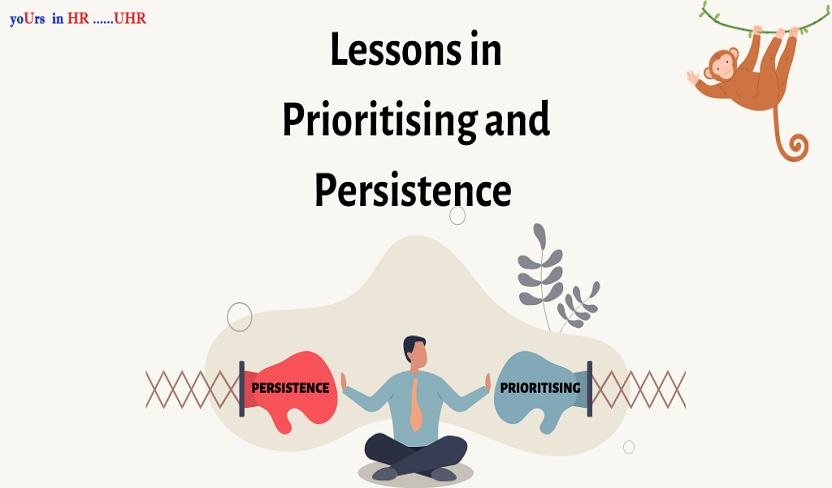
You have been asked to train a monkey to sing and dance on stage. We know, it is highly unlikely someone is ever going to ask you to do this, but let’s just pretend for a few minutes. Hypothetically.

What is the first thing that you will prioritise? Obviously, the monkey, right?

While this is an obvious answer, it could happen that you also want to make the stage look nice and spectacular. So, you spend some time building and decorating the stage. In fact, you spend a lot of time building and decorating the stage.

While building and decorating the stage seems like a silly thing to prioritise and you are pretty sure that the major chunk of energy and priority will go to the monkey to be trained, human nature suggests otherwise. Teaching a monkey how to sing and dance on a stage can teach us a lesson or two.

A common peculiarity seen in most of us is that we like to have something concrete. A tangible result is what we aim for. As this article which acted as an inspiration for our write-up points out, we like to have something to ‘show’. Building and decorating the stage is a much easier task than training a monkey to sing. It is also a result that will be visible more quickly; it will be more noticeable. It’s a faster to achieve job.

We often end up engaging in a similar error in prioritising our tasks. We also end up doing something similar to our larger goals and dreams. We want to have something concrete to show. Having something concrete to show is a practical strategy, of course. But we also want to have that concrete thing now. That is where we tend to lose focus from the bigger picture, and we end up over-prioritising things that can are easier to do and will take less time. When the audience comes, we want the monkey to be able to sing. A well-built and well-decorated stage makes no sense if there’s no performer there. A false sense of working hard might set in. Harder work is to wait for the results to show.

We will go back to training our monkey now. Training the monkey to sing and dance will be difficult. It will cost one patience. More time, more energy, more skills to be developed, more training required on our part. (I mean, most of us aren’t equipped with the skills to train animals, forget teaching them to sing and dance, right?)

Again, something difficult often requires more time and effort, but just because a concrete result isn’t there yet, doesn’t mean that there is no result in progress. Learning something difficult, prioritising something difficult could mean that we may not have much or anything to show for some time. Skills take time to develop. Behind one single achievement, there could be months and years of work. A performance might be fun and enjoyable to everyone else, but the one who has trained and the one who has been trained have put in immense work, invisible to everyone else.

So, the next time you want to think about your priorities, think if you need to focus on training the monkey or decorating the stage. The next time you feel frustrated in a project, think if you are frustrated because you haven’t found something concrete, or frustrated about the time it is taking to ‘show’ something. It takes both, prioritising and persistence.

A Little Stress can make you More Productive

Most of the times we are told about stress and its downfalls. By now we know the kind of risks and diseases that a chronically stressed lifestyle can lead to, thanks to the tons of coverage about how stress is bad. But what if stress could be used in a good way? What if we told you that there’s a good kind of stress too. Read on.

Psychology calls it the ‘eustress’. Eustress is the kind of a positive stress one feels and something that can propel us to do a job well. How does the good kind of stress help us?

Gives the Push:

The good kind of stress can push us out of procrastination. Often, we do really good work around deadlines because the push of the stress makes us come up with really good workable ideas. We may wonder why we do our best work when there’s an outside pressure and the reason is that the outside pressure works as the ‘good stress’ that makes us get up and do the work needed. Say for example, a little nervousness, just a little, can lead to a good meeting as the nervousness will ensure we try our best, instead of taking it lightly and not giving our best. 

Being stress-free all the time can lead to stagnation:

While we are encouraged to live in a stress-free state and chronic stress should definitely be avoided, living on the other spectrum of absolutely no stress is not only unrealistic but also not very feasible. Some ‘tension’ is a good thing. Feeling a sense of lack, or feeling a sense that there is more to be achieved is a good thing. It ensures we don’t remain stagnant and continue to find ways to move forward. Or think of it this way: things that are just lying around, not looked after, not stressed after gather up dust. That little stress is needed to brush up the dust.

The little inkling of stress that we are not living up to certain expectations, whether our own or someone else’s ensures we assess our situation and options. If the little stress compels us to invest in a side business, or that little tension that we may fall behind lets us undertake upskilling tasks, then that little stress, the little tension is a good thing, isn’t it?

Being stressed means that we care:

And caring about something is a great quality to have. Again, only if we care about something, whether it is our finances, our career, our family or our personal growth, will we be stressed out about it, and we will take steps to make things better. Or else, it leads to, as we mentioned before, stagnation. The opposite of care is apathy, and apathy not only leads to insensitivity towards our fellow human beings but also a sense of pessimism. ‘Why bother about things, they have always been like this’ isn’t an attitude that can lead to progress, industriousness and the urge to make things better in our own way.

Being stressed is a sign that we care, and instead of running away from the stress, or sweeping it under the carpet all the time, it might lead to something good. Whether it’s a push to come up with great ideas, or the push to change one’s life for the better, one step at a time.

Don’t give up just yet!

If you grew up in a world that didn’t have computers and much modern technology all the time, you probably found many different ways to pass time. One of those would be solving a Rubik’s cube. Solving a Rubik’s Cube can be frustrating, before it gets rewarding. It can test your patience before it can give you a reason to rejoice.

A similar thing can happen beyond a simple game of Rubik’s cube. Things can get worse before they get better. We are often very close to giving up on something and then suddenly, just as we loosen the grip, it all falls into place. Before giving up on anything, it might do us good to keep this in mind: we might be very close to a breakthrough without realising it, even though nothing seems to be working in our favour in that moment.

In addition to the situations when we have been persistently trying hard at something for some time, things can also feel like they are going worse before they get better in scenarios such as changes in operations, management, strategies, and anything new that is implemented. We might feel like the change is not working so far, and hence it must be time to give up on the change and call it a failure.

What can we do to ensure we don’t give up too early?

Be okay with the discomfort of the process: Many of us give up on projects and things when we encounter the discomfort or perception of failure. We might see no results as we pitch in to that client day after day, or we see no results as we continue on a new project, and that absence of an external cue of success can be uncomfortable. The lesson here is to remember that process takes time. We might not realise it, but that client might get impressed by our persistence, and finally agree to our request. Or it takes one tiny breakthrough, built upon the foundations of our earlier hard work on a project, to turn things around. The key is to embrace the discomfort that comes with the process of doing something and not seeing immediate results.

Embrace the journey: It is often an overwhelming focus on the end result that makes us impatient and oversensitive to setbacks. Solving a Rubik’s cube might not be as frustrating if we actually focus on solving it, instead of thinking what a great achievement it would be if we solved it. Embracing the chaos that comes with starting anything new will make us more prepared to deal with the chaos, instead of focusing on negative thinking patterns such as ‘I should never have started this/we should never have decided to introduce this xyz strategy’. Taking it one step at a time, learning from each step, and being curious where our next step takes us and teaches us would be a better mindset to have than being in a rush to get to the end of the task.

Whether ongoing or new tasks or ideas, things might get worse before they get better, because it is after all a process. Processes are rarely smooth, and processes are often rollercoasters with their thrills, drops and highs, disappointments, lessons and tiny achievements before we can end up on the finish line, and look back at the wonderful journey we have had. Don’t give up just yet!

What is Job Crafting?

Job crafting helps one find little ways to make their job more interesting.

Job crafting is the latest buzzword doing the rounds all over our social media and LinkedIn feeds.

The thing with buzzwords and jargon is that often what they ask of us is unrealistic. At best, they are at times irrelevant and just add to the noise around us.

What exactly is job crafting and is it something that is realistic, doable and achievable without sounding outrageous and demanding by a normal employee?

Let us quickly look into it. Job crafting involves seeing the job description as a work in progress, and finding ways to make it more aligned with one’s goals, strengths and values. It is a bottom-up approach.

However, that does not mean employees should be reshaping the jobs such that they don’t have to do what they don’t like. It is not about throwing responsibilities away or Quiet Quitting. As suggested in our earlier article about Quiet Thriving, job crafting is a lot about shifting perspectives. Job crafting is about finding ways to do more of what makes your job more enjoyable.

In our earlier article about Quiet Thriving, we mentioned how a shift in perspective can help us see our jobs in a new light. That too is a kind of job crafting, at the cognitive level. Finding a new sense of purpose in our jobs is also a kind of job crafting. Let us take a look at a few aspects about job crafting in a little more detail.

Task crafting:

There are some tasks which we genuinely find interesting and motivating. Finding the tasks you enjoy and crafting your role to do more of those is what task crafting is all about. This could involve talking to your manager, and asking them to assign you more responsibilities that you enjoy. It can also be about finding new challenges and avenues to learn, and hence can also involve asking your manager to assign you a different than usual role in group projects.

This little tweaking can go a long way in helping one see their work in a new light, helping to break the monotony and finding healthy ways to channelise the need to be challenged and combat the boredom that may have set in over time. For example, you may come to realise that you love interacting with new people. Communicating that with your manager might mean that you get more responsibilities that involve interacting with new people, such as mentoring new recruits, meeting delegates from other companies and so on. This is all about gaining a fresh sense of enthusiasm about your job.

Speaking of a fresh sense of enthusiasm, social support at workplace can go a long way in enabling us to keep our motivation levels in check. Read on.

Relationship crafting:

People, aka, colleagues are an important part of most jobs. Relationship crafting is about consciously trying to better your relations with your colleagues. While many of us do enjoy simply coming to work and doing our job, without needing to interact with people much, some basic cordial rapport building is important.

Relationship crafting, that is, trying to build some rapport with the colleagues enables one to find some social support when the work itself might get challenging. A good rapport with colleagues ensures some community and network building at work. It also can get us going through good and bad times. While your job description may or may not really mention the need to work interdepartmentally, establishing a good rapport with people from the other departments would add an ease of functioning, access to more perspectives and even more learning opportunities

Amidst the ever-evolving job market, and the demands it brings, job crafting enables employees to ensure their job remains relevant, purposeful, and up to date, with never-ending learning. What’s more, it enables employers to have motivated employees.