

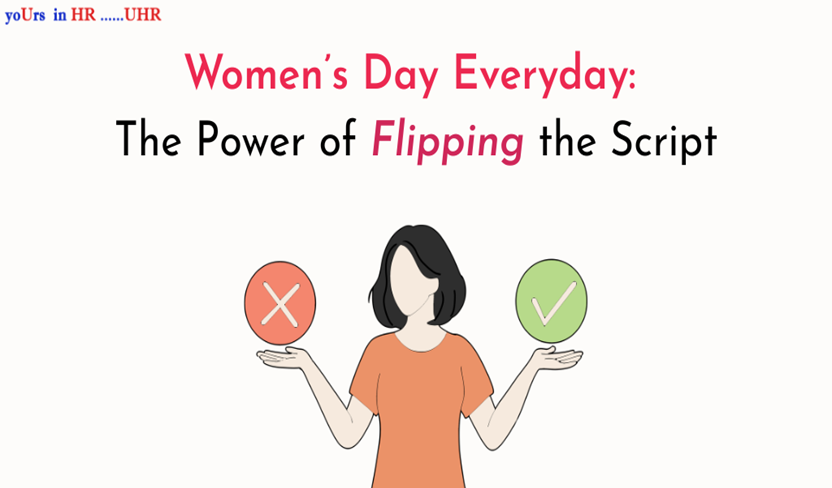
Women’s Day Everyday: The Power of Flipping the Script

A tribute to the woman who knows how to wield her quiet strength, loudly!

It was lunch break and all through it, Ann had a sullen, gloomy expression on her face. She had barely any appetite due to her mood, and had swallowed down her lunch very mechanically.

Sarita, her senior colleague and a friend had noticed this, and had gently asked Ann if anything was wrong.

‘Everything seems wrong!’ Ann had said, as if that gentle question triggered a deep-seated anger, pain and frustration in her. Ann continued,

‘I feel like all these Women’s Day posts don’t mean anything at all. At the end of the day, everyone expects a woman to do everything. She’s made the caretaker of everyone and everything, including herself and her own activties. But no one really cares for her when she needs it!’

Sarita had been listening intently, and now she gently spoke to Ann,

‘I absolutely understand what you mean. A woman is expected to manage her home well, and do good professionally. If she struggles in her career, those struggles are not taken seriously because her career often isn’t taken seriously. If she struggles in taking care of the home, that same career is blamed.

‘When someone in the family falls sick, she takes care of them, but when she falls sick, she almost always never receives the care that she gives. She starts receiving the care only when everyone realises the home management has taken a hit.

‘If she does receive good care without having to ask for it, that is considered an exception, when actually that care should be the norm… ’

Ann had been nodding hard at all these points that Sarita was making.

‘Yes, this is what I mean. Don’t you find it frustrating? This huge burden of expectations, this tight-rope balance?’ Ann asked Sarita.

Sarita responded, ‘I agree with this too. However, I have something to say, which might turn your frustration into a calm motivation.’

‘What is it?’

‘You said how a woman is turned into a caretaker. How about we flip the script here, and think of a woman not as a caretaker and instead as a caregiver?’

‘How so?’

‘We can think of it that a woman chooses to balance her career and home. Not because she is made to. We all know women who successfully do so. We also know women who choose to successfully prioritize home, and let their career become a second priority. We also know women who do vice versa. Maybe, even if the society did not make her balance it all, she’d still want to do that, because she is capable of making a choice for herself.’

Ann at this point had become more pensive, and less angry. She nodded, calmly, and not as vigorously as she had done earlier. Sarita continued,

‘I do agree that even in 2026, many, many women are not fortunate enough to have this ability to flip the script, that is, of making choices and not have choices made for them. The change perhaps can begin with us. Think of it celebrating Women’s Day every day…’

‘How so? How do we celebrate Women’s Day every day?’

‘Women’s day every day means assuming that whatever a woman does, it is based on careful thought on her own part. That it is her choice. It means assuming that her gentleness, her care, her kindness, her priorities are displays of her strength and not her weakness. It means assuming that even in circumstances that may or may not be the best for her, she is in charge of her own decisions. It is assuming that strength can be loud, assertive and powerful, but also quiet, gentle and kind. Sometimes, these qualities are seen separately and sometimes, they intermingle beautifully.’

Sarita continued,

‘We should definitely continue to empower the women who do not have the privileges and freedom we take for granted. But we should not assume that a woman does not have the strength to make a decision for herself, no matter how dire the situation is.

‘Think of it this way- within the limitations which may have been imposed on her, she will still most likely decide to do what is best for her, in that situation. Of course, I am not saying the situation will always be good and that it shouldn’t be improved. My point is that women are incredibly strong. And one can be strong in many ways. We have a quiet strength that doesn’t fade, whatever the situation might be.

We are not mere caretakers, passively taking care. We are caregivers, because we willingly give that care. And this is how we celebrate Women’s Day every day- by reminding ourselves about this quiet strength, that knows when to become loud.’

And that, dear friends, is the power of flipping the script! Team UHR extends warm Women’s Day wishes, to all the strong women. We salute the strength that can be quiet, gentle, kind and loud, powerful, assertive in equal measure.
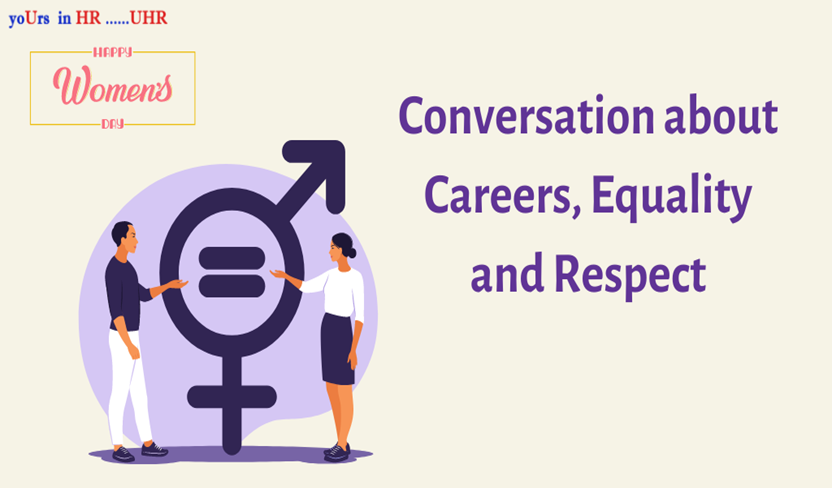
Conversation about Careers, Equality and Respect

Having equal respect for the variety is the key.

As Women’s Day as approaching, familiar conversations about gender and women empowerment would be coming up. While equality remains a common point of conversation while talking about these issues, it is also worth examining what are we genuinely looking for when it comes to equality, and if there are areas where we need to understand if equality is something that is the genuine need, or perhaps something more nuanced.

Respect and Equality:

The way men and women have to take up roles and responsibilities in a family setting, typically is not the same. While conversations about redefining gender roles and having a more ‘equal’ atmosphere abound, the reality is that the genders are different, and how a woman might handle a conflict, raise a child or manage her work will be different than how a man does.

Equality doesn’t simply denote ‘sameness’; it should and denotes equal respect. Perhaps, the need then should be to pay equal respect to approaches that a man and a woman might take to their responsibilities instead of simply saying things like ‘men and women are equal’. Men and women are different, with different ways of approaching personal and professional lives, and it is the differences that need to be equally respected.

The Different Approaches to Career:

Take for example the way a woman’s career trajectory is often looked at. Many times, life-stages like motherhood are considered impediments to her career! Not to mention how men are most of the times denied the importance of paternity leaves. How ‘gendered’ is our notion of a career! Organisations and personnel connected to management might benefit by understanding the difference in approaches to career, specific to the demands the two genders are faced with. An article by Harvard Business Review brings to notice some crucial points to keep in mind when it comes to questions about careers of women:

  • Pausing one’s career to look after domestic demands is not a bad thing. In fact, it is sometimes necessary and even in that pause, development doesn’t stop. Skills from time-management to personnel management are developed through the domestic duties that women often traditionally end up taking.
  • A slow pace is still progress. Say Mrs. A had a child, and in balancing her professional life, and looking after a small child, her career’s pace got slowed down. She remained in one post for around 8-9 years. Does that mean she would have no opportunity ahead? Does that mean she shouldn’t resume at a faster pace when the child has grown up enough? Does a slow pace mean a complete impasse? Of course not. A career can still be fruitful and successful, even with a slow pace. One can take pauses while climbing the ladder.

In other words, the time and intensity with which women can engage with their careers will be different than how a man does. As a result, the approach they take will also be different. That difference in approach, rather than being seen of a lesser value, and as makeshift, should be seen as an approach that is as necessary, valid and respected.

In an age of uncertainty, and of times when both men and women are faced with crises that challenge them to be better versions of themselves, it makes sense that we all act in support of each other, rather than competing unnecessarily. Variation in approaches in problem-solving, whether personal or professional, should be explored with an open mind, and a curiosity, rather than rivalry, animosity or the need to overly simplify ‘equality’. The first step lies in establishing respect for the differences.

Team UHR extends warm wishes for Women’s Day in advance!

Professional Lessons to learn from Diwali Festivities


Article Images (2)

As many of us know, Diwali is not just about a day. The festivities and the rituals begin right from Dhanteras, and go on for days till Bhai Dooj.

Now, here are some professional lessons to be learnt from the five days. Don’t worry, we are not asking you to work during the holiday season, but the following lessons can always be implemented after you come refreshed from a Diwali break.

 Dhanteras:

This day, the thirteenth day of the dark fortnight of the month Kartik, is associated with cleansing and purchasing.

The day gives us lessons about the importance of getting rid of chaos and old clutter , and thus make space for order, novelty and freshness.

In the office space, it is similarly necessary to get rid of old, obsolete technology, and be up to date with the emerging trends. Plus, it is a great idea to keep the work station clean, tidy and ordered. There is known to be a positive correlation between work efficiency and a well-lithygienicpeaceful work environment with minimal disturbances.


 Chhoti Diwali:

The fourteenth day of the fortnight is associated with preparation of sweets using various ingredients like flour, semolina, dry fruits, milk solids, etc.

Remember how the various sweets are not simply “sweet”, but the taste of the main ingredient always lingers? Be it milk, cashews, almonds, pistachios, there is an instant recognition.

It would do us good if we keep this in mind: it is necessary to retain one’s essence to gain recognition.

For example, an HR manager of any company, would prefer a candidate who is honest  and transparent as opposed to someone who is showy (flamboyant) and ingratiating.

Sooner or later, the inner qualities of that candidate would be recognised, like the main ingredient of the “sweet.”


Diwali:

Here comes the festival of lights! There is sound, there is colour, there are feasts, there are Pujas performed, there is celebration everywhere! The young people visit and take blessing from the elders. Oh, and there are diyas, rangolis!

In the professional lingo, this teaches us the importance of good networkingbonding, the importance of mentors. It tells a lot about the power of one small diya. About the power of one single colour to add that missing touch in a rangoli. Sometimes, a rangoli remains incomplete without that one colour. Team work is the Key.

A line of diyas has the capability to light up an entire place. Collaboration, not competition is the way to go.


Govardhan Puja and Bhai Dooj:

Govardhan Puja is celebrated to mark the feat of Shri Krishna when he lifted up a mountain to save cowherds and farmers from incessant rains. Some regions celebrate this day as a New Year, and some as the Annakut, literally mountain of sweets. Some celebrate the bond between husband and wife.

Bhai Dooj celebrates the bond between brothers and sisters, here, the sister acting as a protector of the brother.

Anyhow, the two days teach us a lot about the importance of being supportive to our colleagues, especially in the time of crisis.

Taking responsibility, having empathy, handling interpersonal relationships effectively are some of the lessons we can take with us. It tells us about the importance to have Emotional Intelligence. In short, the importance of taking leadership in little things.

Emotional Intelligence could be used in handling meetings, negative feedback or appraisal, client relations, empowering your colleagues, etc.

Diwali festivities not only give us good times, but good lessons which could be applied in a professional setting.

Delving into meanings of festivals and traditions, could help us a great deal to understand the values and their timelessness.

Happy Diwali!


(This article has been reposted by us.)

GO VOTE!

VOTER IMAGE 4

Today, we are not going to tell you anything about interviews, meetings, recruitment, or anything about the world of work.

Today, we are just urging you to make full use of your right and GO VOTE!

We did.

-Team UHR

Blood Donation Camp at UHR

edited bd - Copy

Do you wish to contribute to the society in any little way you can?

Have you been thinking of donating blood? Has the concept scared you?

Blood donation is something that is considered a noble activity.

But the word ‘blood’ itself scares a lot of people, forget progressing to ‘donation.’

We are organising a Blood-donation camp at United HR. And we would encourage you, and your Team Members, friends and family to come along and donate! Blood-donation is a rare opportunity to contribute to someone else’s well-being. It’s time we put aside the myths and look at the advantages of donating blood.

Moderation of Iron-level in Blood is one of the most important advantages of blood donation. We have been told since school days that vitamins, minerals, proteins, iron, etc., are necessary for a healthy body. But did you know having too much iron in one’s blood could actually increase chances of heart-disease? And too much iron also increases free radical damage in the body, which has been linked to an increased risk of cancer. Blood donation, by moderating iron levels gives rise to a whole new set of advantages like:

  • Reduce the chances of a heart-attack by 88%.
  • Lower the risk of severe cardiovascular events like stroke by 33%.
  • Lowers the risk of cancers of liver, lung, colon, stomach and throat. Studies supporting could be found in Journal of National Cancer Institute as well as corroborated by Miller-Keystone Blood Centre.

Blood donation also gives you a chance for:

  • Free Blood Analysis– A blood donor receives a free prior health screening plus mini blood test. The HB level is tested, as well as blood pressure and body check is done. The donor is also screened for syphilis, HIV, hepatitis, and other diseases; and is immediately informed in strict confidentiality if any of these tests show positive results.

One might think blood donation might “take away” something from one’s body. The donor’s body immediately begins to replenish the lost red-blood cells within 48 hours of blood donation. The donation thus:

  • Stimulates the production of new Red-Blood Cells.
  • Helps to burn calories. It helps burn about 650 calories for every pint, i.e 450 ml of blood given.

 Dizziness, nausea, light-headedness, fainting are some extremely short-lived side-effects which some individuals do face. But those are very normal and not everyone faces these. To ensure that the process is safe, blood donation should be done in a professional, hygienic environment where proper medical attention is given. It should be done under the supervision of experts. We at United HR have ensured that all these requirements will be met with in our blood donation camp. Details:

Date: 17th August 2018,

Venue: At the Swastik Society Hall,

Swastik Char-Rasta,

Off C G Road, Near Domino’s/AroDrape, Navarangpura,

Ahmedabad-380009

Timings: 9:30 am to 1:00 pm.