Want to Innovate? Forget the Template!

We often come up with the best ideas when we have no one to follow.

Organisations and individuals often look up to success stories. Success stories inspire us. They provide guidance and templates to follow for future. But what if we told you that some of these success stories might be stopping innovation?

What if we told you that sometimes the only success story that can lead to innovation and new ideas is when the success story didn’t follow a different success story? Read on!

  • Sneha runs a successful start-up. Years ago, when cloud kitchens were not all rage, she started her business of delivering home-baked cakes based on custom orders. Today, amidst all the cloud kitchens, her business remains as successful and has a loyal set of clients and customers.
  • Naveen opened a bookstore in his small town. It was the only bookstore in the town back then that sold second-hand textbooks for college students. The other bookstores mostly sold books for a national and international readership. Naveen’s family had wondered if he squandered his prospects and whether he would ever get recognition or dealerships. Years later even as other booksellers realised the needs of college students over the years, the bookstore Naveen opened remains the most trusted one. 
  • Shayan is a successful graphic designer working in a big firm. He is successful because no one in his family is a graphic designer. Yes- that played a major role, apart from his own skills and competence, of course.

In all the three scenarios above, one thing stands out.

It is the absence of a template to follow.

Think about it. When we have success stories and role models around us, we tend to follow them. The stories inspire us and lives of role models guide us.  When we know ‘tried and tested’ formulas to anything, we tend to rely just on them. Almost naturally, we become a follower instead of an innovator.

But when we have no fixed and tested route, when we have no one to look towards for guidance, something magical happens:

We think. We innovate. We find ways to make our seemingly ‘odd’ venture a success. We have the will and we find ways to implement that will. Our path is full of surprises instead of roadblocks of caution. Along the way, we become leaders.

Alongside the success stories, there are failure stories that are although spoken of in hushed tones are also spread far and wide. Things we should avoid. Well meaning friends and family have cautionary tales:

‘If you do this, that might happen. Look what happened to…’

‘If you are not careful, you will end up doing…’

‘Don’t you know if you do this, that horrible thing will happen..’

But when we are the first ones to do something, no one to look up to, no ‘knowledge’ of failure, we have nothing to scare us. No cautionary tale. No tried and tested trade tricks to rely on. No unwritten rules, because you are yet to write the rules!

Sometimes, organisations end up doing things the ‘way they have been done’ since years. The processes aren’t new. So, how can we expect for a new outcome?

What if organisations instead were to start certain things from the scratch? Maybe rethink the process innovatively, and build the process from scratch. New process. New outcome.

Of course, tried and tested paths, processes that don’t need fixing, and age-old wisdom isn’t something to abandon. Not at all! But the next time your organisation struggles innovating, or you wonder how you will manage to do that thing you want to do, or when someone makes you wonder how you will manage to become successful with no models to look up, no templates to refer to, no guidance to follow, remember that maybe you are the one who will make the rules, set a template and guide others in future. Maybe you are meant to be the innovator. Maybe it’s time for a new process for a new outcome.

Whether it’s thinking about a personal venture, or just our day-to-day operations in our office, sometimes, the lack of a template to follow, the lack of a known path already made might be a ticket to innovation.

Expect More from Yourself, But Don’t Underestimate Yourself

We often ignore what we are already contributing, while focusing on the ways we wanted to contribute but couldn’t. Read on.

Diya had been working at a designing firm for a couple of years now. While she had many years ahead of her to go still, she had been experienced enough to be considered as a mentor to the younger joinees. She was the perfect go-to person for them, when they felt intimidated by the older colleagues and out of synch with colleagues who were younger than them but had joined earlier. She was a great person to have on the team.

Diya was also a diligent employee in many ways: she always came to the office on time, had excellent skills required to do the job and had great work ethic.

But for Diya, these did not feel like great contributions. She felt she didn’t add much to the office, and felt herself replaceable. She thought anyone would be able to just work hard and fill her shoes. She felt she didn’t add anything to her company in general.

With these gloomy thoughts, she was sitting with a gloomy face in the lunchroom one day. That day, through a happy coincidence, her senior Swati walked in and saw a sad looking Diya. As she sat down with her and asked what the reason was for her dull mood, Diya told Swati bit by bit about feeling she doesn’t contribute much to the company in general.

When asked the reason for feeling this way, Diya said,

‘I have seen other colleagues take ideas to the boss. Every week someone walks into boss’s cabin and gives them ideas. I only give ideas when a client gives us the brief. Every week, I see juniors brainstorming something together and I admire them but also wonder why I couldn’t come up with that. Every week I look at a senior and see their portfolio, and I wonder if I will ever reach where they are…I am just so boring and replaceable.’

While Swati understood Diya’s frustration and her tendency to compare, she was also astounded by how Diya was underestimating her own self this way. Swati then told her something, which helped Diya and can very well help us as well. Because, let’s face it, whatever profession we are in, we may have felt like Diya many times.

So, what did Swati tell Diya? The advice, by the way, is a real advice by writer Shane Parrish: In focusing in on all the ways you want to grow and contribute, do not lose focus on things you are actually contributing and doing well.

It’s good to be self-aware and find opportunities to grow and learn. It’s good to try to understand where we are lacking, so we may focus on how to grow in that aspect. But in that process, we shouldn’t forget:

  • Expectations Vs Reality:

Our expectations are so fixed at times, like Diya, that we forget the ways in which we are contributing in reality. Diya wanted to bring more ideas to the table, she wanted to make an impressive portfolio for herself. But she forgot to look at the way she was already contributing, such as being a hard worker, a dependable person willing to spend time to understand the client’s requirements properly, a great team-player, a wonderful person to act as a bridge between the different age-groups in her office and so on. This brings us to the next point.

  • Blind to our Own Strengths:

We may also be blind to our own strengths and contributions because of our expectations from ourselves. We often contribute in other ways which we may not necessarily be aware about. We may want to learn how to network better but we may already be a great person to handle logistics. We may want to learn one skill better, but there might be other skills we are great at but since we don’t ‘want’ those, so we are blind to those. How unfair to ourselves!

While focusing on a way to fill the lack, we shouldn’t lose sight of the abundance we bring in other ways. It’s good to expect highly from yourself, but sometimes the reality of how you are is in itself great too!

Father’s Day: The Ground for the Sunshine

We celebrated Father’s Day recently. Some thoughts on foundation, ideas, leadership and risks. While the mother provides her warmth like sun-shine, the father does it differently.

Father’s Day just went by. We must have seen posts, received and sent messages and celebrated in our own little ways.

Fathers or father figures often are seen as providers and rarely as nurturers. It is often considered the mother’s ‘job’ to nurture and care, while the father is sadly placed outside of that invisible circle. But the truth is fathers also provide nurturing and care but in different ways. In fact, the paternal way of showing care can be transferred into many a lesson about leadership, calculated risk-taking and implementation of ideas.

Keeping Calm, to Keep the Spirits Up:

Often times, it is said that men struggle with expressing their emotions. There might be some truth to this: it is important to display your vulnerable side and being in touch with your feelings is the first step in managing them. However, it is also important to at times keep up the self-control and display calm. Not to suppress your feelings but to keep a strong team morale. When crisis hits, fathers provide a sense of protection, not just through their actions but also by their way of being.

Think about the times when one team-member panicked and the entire team, as if through a domino effect, started panicking. Think about the times, on the other hand, when through a calm and composed problem-solving, solution-oriented approach, the entire team found a way to power through the problem.

Love, through Simple Actions:

It seems a common experience of many: mothers are great at showering us with affectionate words and actions both- the warmth is there to feel immediately, no questions asked. How do fathers show affection? Well, it is more through small acts of love. Mention you like oranges to your father once, and you may have a bowl of oranges lying on the table the next day. For fathers, showing care is through the quiet resourcefulness of having the phone-numbers of important people, right from a mechanic, to a computer engineer in their phone book, ready for everyone’s use at an instant. 

In our management with clients and colleagues, it is worth noting that it is only through small cumulative actions and quiet resourcefulness at the end of the day that determine how successful an agenda, idea or plan has been. Elaborate plans, post-it notes, vision boards, agendas might be set, but it is the persistent implementation, working on it with our heads down that will determine whether it gets actually done or not. It is the quiet resourcefulness of knowing who to contact when, when all the elaborate networking will actually provide fruition.

Fun and risk, at the right time:

Look at a father during holidays, when he isn’t away at his office, and you will see him giving his kids the times of their lives. Whether it’s through big and small travels, or through playing cricket with them, fun with fathers has its own separate joy. In fact, mothers also feel safer through his presence, and when ordinarily she may have restricted the child from doing something, she lets them have fun, since she knows the father will manage everything.

In our dealing with matters of work, it is crucial to add that ‘fun’ element of calculated risk. The one little step we take that may or may not be a part of the original plan but something we felt we should do. That one client we feel we should take a chance on asking once again even when ‘logic’ says something else. That one call we feel scared to make but do it anyway. That one plan we have been waiting to go forward with when the ‘right’ time comes.

Mothers and fathers complement each other. It is almost impossible to talk about one without mentioning the other. One nurtures by providing warmth that radiates in all directions, impossible to miss, and the other provides a quiet ground to grow on, stable foundations, with deep roots. Mother and father, like the sun and the earth.

Relax! Let Time Decide Your Success

We often rely on external encouragement, rewards, appraisals, feedback to know how we are doing. But what if we just let time give us the answer? Read on.

Savi had always been a powerhouse of ideas. And ideas which she would implement with great gusto. She had an idea to open her own business and she had been successful with it. Within five years of opening up her ceramic’s dealership, she had procured prestigious client companies. But now she seemed she had hit a roadblock. She was wondering what the next move should be to make the company innovate better. Daily, she would brainstorm with her team, network with clients trying to understand their needs. Daily she would get a couple of new ideas to implement but she would feel like the ideas weren’t good enough.

Ruturaj had started a new job at a company. It wasn’t a new career for him but it was a new company culture he was dealing with. He was good at his job, but he felt he wasn’t doing enough. He showed up to work, gave his best, observed, asked, learnt what was to be learnt, integrated that learning, and repeated this productive cycle. The problem was that he wasn’t able to see this cycle as productive.  He felt his efforts were not enough.

What was going on here, in both these cases?

Some might say there was no immediate feedback available to Savi and Ruturaj. That is partly true. Some instant feedback- a quick review from her clients or other sources about whether Savi’s ideas were worth implementing or not, or a quick word from Ruturaj’s boss whether he was doing well or not may have helped.

But the problem is that sometimes it takes a while to get that feedback. Even if Savi’s clients found her ideas to be worthwhile, whether they were actually worthwhile will be known only over the months and years of implementing them. Even if Ruturaj’s boss appreciated his hard work and gave him a good appraisal, whether Ruturaj proves to be a good hire for the company will be known only over the months and years, with how Ruturaj handles new projects, manages crises and grows professionally.

Success and growth, especially professional, at times can only be gauged truly over a long period of time. Appraisals, reviews, awards, or even an instant appreciation are there, but ultimately it is time that decides what has worked or not worked.   

Success and growth, also requires you to have an optimum level of confidence, where you trust yourself enough to do your best, and yet remain open to course-corrections others might suggest. On the flipside, excessive self-criticism, to the extent that it stops you from trusting your own skills and competence is also not a good path to take. Like how in Savi’s case, she finds something always lacking in her ideas, or for Ruturaj who just doesn’t see how well he is settling in.

So, what can Savi and Ruturaj do?

Stop working, stop caring about reviews and feedback? Of course not.

Should they stress and work even more, feel all overwhelmed that there’s no way for them to know how they are doing? No. 

Well, the answer is neither this nor that, but ironically both! Savi and Ruturaj should continue to give their best. They should continue to learn, brainstorm, to ask, to work hard. What they don’t need to do is worry too much about how they are doing, especially if there’s no way for them to know after a certain point. What they need to do is just show up consistently, do the work that needs to be done in the best way they can. How they fare ultimately will be decided by time. As the Bhagvad Gita says, keep doing your karma and dharma (your work and your duty), without worrying about the fruit. We will see the fruits of our efforts only when the time is right, and that is in no one’s hands. And that is the relief all of us should feel.  

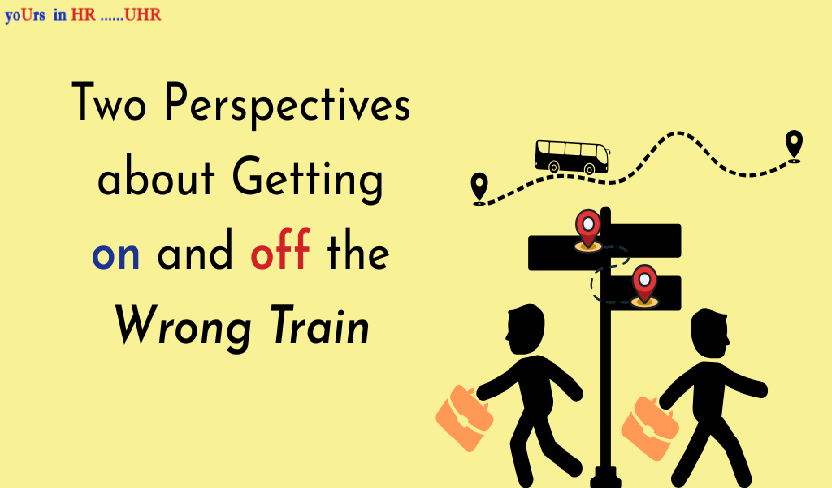
Two Perspectives about Getting on and off the Wrong Train

Life sometimes puts us on the ‘wrong train’. How to decide if we need to get off the train or just enjoy the view?

Life rarely goes as planned. Maybe you didn’t plan on the having the job you currently have, even five years ago. Sometimes, we chase after opportunities and sometimes, we are made to create opportunities for ourselves. We decide on one thing and another thing happens. There are two perspectives to these ideas about change (of life and plans of life for us) and growth.

The Cost of Change:

There’s a well-known Japanese proverb that goes:

“If you get on the wrong train, get off at the nearest station. The longer it takes you to get off, the more expensive the return trip will be.”

This can be applied to so many scenarios of life:

-Feel stuck in a job you don’t like? Quit before your mind gives in to the habit of comfortable misery. Get off the next station.

-Feel stuck on an idea you know doesn’t seem to be working out? Stop and check if you should put it on the side for now, quit or course correct. Decide the ‘station’ you want to get off and do that before the train rams into your sense of competence.

-If a project needs you to test something on a user, test on one user, in a controlled environment, so in case there’s a flaw, it doesn’t reach thousand users later. Decide if it works and make the required changes as early as you can. The more you stall, the more expensive the return ticket becomes. As the writer Steve Krug puts it, ‘the cost of change grows over time.’

The Suprises of a Journey:

On the other side of this coin about ‘getting off’ from the ‘wrong train’, there are countless writers and philosophers from across the world that remind us how it is the journey that is more important than the destination. One may get on the wrong train, one may not reach their originally planned destination. But they still get to take in new, undiscovered scenery. The ‘wrong’ train may eventually make us find new a destination we didn’t even know we needed.

This too can be applied to many scenarios in life:

-Stuck with a job which you didn’t plan on having? Might as well learn something about it now and try your best to do it well, with your full presence. We may know people professionally who didn’t plan on getting in a career they are in right now and somehow, managed to be at the top of that career they ‘originally’ hadn’t thought of choosing.

-Your initial idea has turned all topsy-turvy and you don’t know what to do with it now? Maybe there is a new direction your idea is meant to go in.

-Testing on a thousand users led to a different outcome than anticipated? Maybe think if the users can still benefit from this ‘new’ outcome.

Getting on a wrong train may either lead you away from your planned destination, or it may lead you to a destination you were more suitable to go in. Our decision then lies not in quitting, or staying but deciding the cost of staying on the ‘wrong’ train. And both decisions can be sensible ones depending on our situation. Some questions we may ask ourselves are:

  • Is the cost of change likely to make your life miserable?
  • What will you lose if you stay on the wrong train?
  • Is there something you may gain if you stay on the wrong train? 

These are the answers we need, which may help us decide whether to get off at the next station or enjoy the scenery. So dear reader, would you like a new ticket or would you like to get off at the next station?