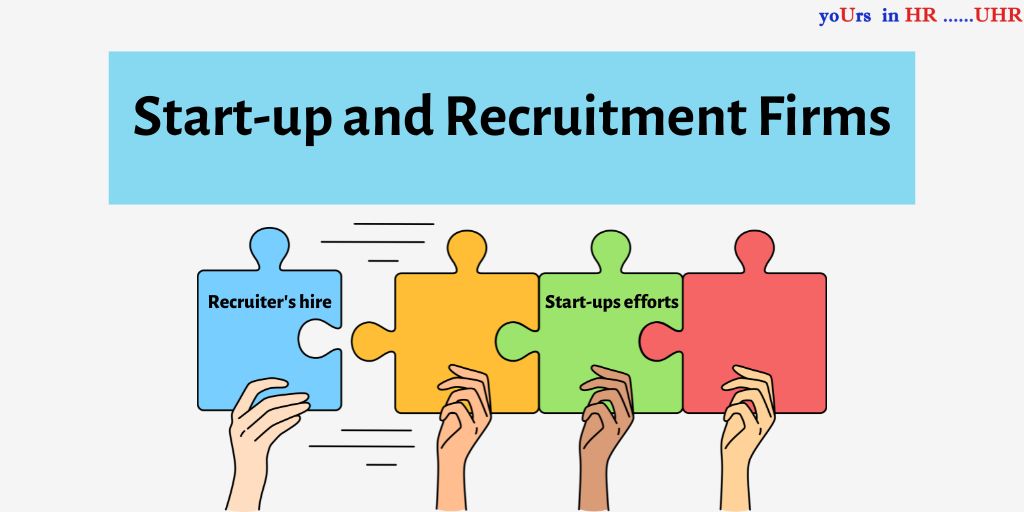
Start-up and Recruitment Firms

Start-ups have been springing up all around since many years now. As we have discussed in one of our earlier articles, it is actually a good idea for start-ups to take the assistance of a recruitment firm when it comes to hiring.

Times have changed a little, and now more candidates might be ready, even enthusiastic, to work for start-ups, especially the millennials and the Gen-z who are (in)famous for jumping jobs, looking for better opportunities. They want purpose and meaning, and not just a stable job.

Let us see how recruitment firms can further help start-ups when it comes to hiring.

Helps in establishing the credibility of the start-up:

Start-ups are generally in the process of creating their ‘brands’ as we have discussed in the earlier article. A ‘reputation’ is still a work-in-progress thing. A recruitment firm, with its proper process, right from the initial job-posting, to the client-network that it taps into, will help the start-up to establish credibility.

Despite the progressive attitudes, it is still tricky for many start-ups to be taken seriously. A start-up is much more likely to be taken seriously when it is backed by the strong hiring process of a recruitment firm, which is well-established and has a client network that trusts its headhunting.

Helps in identifying the start-up’s place in the market:

A start-up is an adventure. It is a product of drive, passion and dedication to be a changemaker. There is the motivation to do whatever it takes. But things can get tricky when one tries to figure out: what exactly does one need to do?

You might work 16 hours a day and still not generate the revenue you want.

You might network with a hundred people, pitch in your brand and perhaps get only one application.

A recruitment firm on the other hand, with its understanding of the market and where your start-up stands within that market, and what kind of talent would be attracted the most to your brand, can get you multiple applications with its one job posting.

Moreover, experienced recruiters have the wisdom of what the competition looks like, and what candidates are looking for, and they can guide the start-ups accordingly in tweaking job profiles and managing their expectations.

Recruitment firms can add the touch of smart work to that hard work.

Helps in understanding the smaller details:

Running a start-up comes with its own legalities and technicalities. Recruiting for a start-up too comes with its own legalities and technicalities.

For example, the various labour laws that are governed by particular countries, laws about hiring if you plan to hire international employees, laws about contracts, laws that govern full-time and part-time employees and so on. A recruitment firm can help the start-up in ensuring that these legalities and technicalities are being followed and complied with.

The importance of hiring the right people:

It is important, correction, more important for the start-ups to hire the right people. Bigger brands and companies have the advantage of higher scale operation and more manpower. This means that the company will function fairly well even with a few vacancies if someone decides to leave suddenly. There will not be any major dent on the overall functioning of the company. The workload will also be distributed in a just manner.

A start-up on the other hand, is much more volatile, and chances are, the workload may fall on a few individuals in case someone leaves. The smaller-scaled operations also mean that a few disruptions about roles and functions here and there might leave the start-up in shambles.

With such a glaring contrast, it is definitely important that the start-up hires the right people who will help in driving their mission forward and who would help in running it well. This is why a recruitment firm, that understands their brand, requirements and expectations would help the start-up in saving much time, resources and money that might go in the costly trial-and-errors of hiring the wrong people.

A start-up may decide to hire a recruitment firm, or an individual consultant. In any case, following a structured recruitment process is likely to help save up time, money and resources. It is likely to help the start-up channelise their labour smartly into more useful avenues. The recruiters will do the job of establishing their credibility, understanding their brand and tapping into the relevant market. The start-up can continue to dream and work on that dream.

Prepare yourself for- ‘Do you have Any Questions for Us?’

As a candidate, have you ever wondered what sort of questions to ask the HR or the talent acquisition team at the company you have an interview with? We have talked about something similar in one of our earlier articles, so let us delve a bit deeper into this. These questions will also help you as a candidate to understand where the firm or company that is hiring stands in terms of what it expects from you, and it will also give you an insight how the company functions.

So, what are the kind of questions the candidate can ask, and the HR should be prepared about? What sort of questions can you ask when they say ‘Do you have any questions for us?’ Note that usually, only two or three questions are entertained, so it is a good idea to pick on what matters to you the most, and think about your questions accordingly.

Questions like:

What is the definition of success according to this company?

What could be my trajectory in this company?

What is expected from me in the coming months/next six months/a year from now?

Such questions can help one understand the expectations the company has from you in the long run. It will also help you understand what are the parameters of success here: for example, based on the answer, you can get an idea if the company measures success through sales, or networking, or by the number of hours clocked in, or project by project basis and so on.

Understanding the parameters can also help one understand what the path to future promotions looks like. This leads us to the next point.

Questions like:

In what ways is this role important for the growth of the company?

What are some challenges related to the role?

Asking a very direct question like ‘Why are you hiring for this role?’ might come across as a little rude and blunt. Instead, the questions mentioned here might help you get more detailed answers from the HR. The answers to these questions are likely to help you get an idea about the big picture as well as the day to day to issues surrounding the role. For example, is there a particular reason why this position is open, or if there’s a peculiar challenge that makes the role demanding in a certain way. This can be a great step towards actually getting prepared for the role!

But hey, the job isn’t just about the work. One might also want to get a sense of the work environment and this leads us to the next point. While it might be tempting to ask the questions about work culture and environment, there is something about those questions that could scream as ‘Red Flag!’ to the HR and it is necessary to use your observations instead of directly asking them. Read on.

Red Flag Questions to Not Ask:

What matters to the people who work here?

What do people like about working here?

Instead of asking the HR directly, keep these questions in your mind, and try to see what is it about the place that the people are enjoying. Moving through the office keeping these questions in mind can help you get a hint of the work- ethic company values, and what kind of a work environment does the company offer. A look at the office-workers’ overall mood, any announcement boards, decorations, how welcoming the desks look, and how relaxed or stressed the people are can give you answers to these questions without directly asking.

As articles by SparkHire and SHRM put it, asking certain questions can help the HR understand that you as a candidate are interested in this job, that you are serious about it. The right questions, when asked, the right things when observed, and certain ‘wrong’ questions when not asked, can help you to understand what it truly means to work at this new place that you are planning to be a part of.

Our Journey of 35 Years

It is September, and along with the festivities of the GOD of auspicious events, a faint tune of the old song ‘Come September’ lingers around. The season of Ganpati is all about new beginnings and blessings.

For us, at United HR Solutions Pvt Ltd, it is the season of gratitude and nostalgia. Why? Because September is our birthday month!

Yes! On 5th September, 35 years ago, we started from a proprietorship concern, called United Consultants, run by a father-daughter duo. From the days when the concept of a recruitment consultancy was new in the vocabulary of the city of Ahmedabad, we have come a long way. This miniscule two-member team grew up to be a franchise network of 10 branches around the country. We transformed ourselves into a corporate structure soon, becoming United Placement Pvt ltd, and later to United HR Solutions Pvt ltd.

What was our Vision? We all had a common Vision with a Mission of Bringing people together with a Human Touch. Since the inception of United HR Solutions, we have kept the Rotary four-way test in mind, especially the bit which asks one to ponder: Is it Fair to All Concerned?

It has been our mission to ensure fairness in dealing with our clients and candidates. Openness about the process and the communication, taking ownership of the assignment to ensure that we understood the needs of the clients and the candidates, alike. We have always stood TALL for our ethics and work culture. We believe in placing the right people at right places, in the right way.

How have we spread our wings, and where has the light of our vision taken our clients and candidates? The continent of Africa had always been our starting point and continues to be the core of our journey. We continue to explore newer territories, and have shown the jyot, the Torch, to Indian professionals in 30+ countries so far. Many of our candidates thus placed have grown in their careers to ranks of GM/CEO’s. We are Proud to call these GMs and CEOs as some of our Regular Clientele.

We continue to spread the light within the Indian recruitment scenario in various hues and shades. Having tasted the work cultures of multinationals like General Motors, General Electric by doing their Turnkey staffing, we moved on to  key role placements in companies in almost every industry. Thanks to our Baroda branch, we have also tested waters in Temp staffing and excelled in Process/ speciality chemical industry recruitments.

In our 35-year-old journey, our strength has been our people. As the name UNITED suggests, they have remained United with us, some of them since the early years of inception. We are filled with a new wave of nostalgia as we realise, we also have people associated with us for close to 20 to 25+ years.

We value their association and are proud of their accomplishments. It’s after all the TEAM which makes the COMPANY, as TOGETHER WE ACHIEVE MORE.

Benefits of Hiring a Candidate with Limited or No Experience

Is hiring a candidate with less or no experience a good idea? Amidst the pandemic induced talent -crunch one could argue that hiring a candidate who can knows how to handle the pressure, the workload, in other words, a candidate who has some experience sounds like a good idea. After all, it takes some wisdom of experience to cultivate that adaptability, that attitude of anything-can-be-figured-out. On the other hand, the talent-crunch also means that companies could be looking for people desperately and amidst it all, hiring a candidate with no or limited experience might be one of the few options they have and could feel like a gamble. Companies, managers might be hiring such candidates reluctantly, and/or might be having major doubts about their competence, preparing themselves for the worst.

Turns out, companies can heave a sigh of relief, because hiring candidates who have limited or no experience has its own set of benefits, as these two articles by CiivSoft and Millennial Magazine point out. Let us quickly have a look!

A Blank Slate:

Candidates with no or limited experience are much more receptive to new ideas. Their lack of experience means they will be eager to learn and get some of that experience. They could prove to be excellent persons to be mentored. Be it learning a new skill, or cultivating a certain work ethic, they are the ones who could be the starting points of the establishing a company-culture you desire as a manager, or as team-leaders.

They are determined to prove themselves, and hence are likely to be much more proactive and hard-working.

Best of Both Worlds:

Some of the candidates with limited experience may have done internships. Or they may have a good hold on the ‘theory’, for example, they might have recently finished their education, leading to a freshness of relevant concepts in their minds. In other words, they would have acquired the relevant skills and knowledge and they would be itching to apply those to practical, real-world use. What’s more, their skills and knowledge might actually be more updated when compared to those of the older more experienced candidates.

The combination of fresh skills and knowledge, coupled with an eagerness to apply is a recipe for getting fresh perspectives and approaches.

Practical Considerations:

Beyond all the considerations about skills, competence, fresh perspectives and approaches, lie the practicality of hiring a candidate with limited or no experience. A candidate with more experience will demand more salary, because they will have the credentials to do so and naturally, the cost of hiring them would be more.

A candidate with less or no experience would be motivated by finding a job in the first place, and they might actually not demand a high salary. Their motivation is to learn and gain experience; the motivation of an experienced candidate is to get a better job, a better pay. (We will go into the nuances of this in our coming articles. Watch this space!)

Of course, it is to be noted that this does not mean that companies should use that as an excuse to exploit the lack of experience through unfair compensation.

What does this mean for the candidate with no or limited experience?

 Well, apply! Apply without worrying whether you have the necessary experience or not. As long as one is willing to learn, adapt, it is never a bad idea to dream big!

Hiring a candidate with limited or no experience can work well for the company in terms of offering fresh perspectives, of moulding the company- culture in the desired direction, of mentoring the workforce of and for the future. Hiring a determined young lad now could prove to be a springboard for a future leader.

Talent Crunch? Silver-Medal Candidates to the Rescue!

Companies have been facing challenges when it comes to finding and hiring talent. Post the pandemic and the WFH scenario, coupled with the Great Resignation, many people, especially the younger generation, often referred to as the Millennials and Gen-Z, have chosen to not ‘go back’ to the office. They prefer jobs which offer options to work remotely and/or have flexible working hours. Moreover, the Great Resignation also saw people resigning as a way to pursue what they really wanted to do. Such factors have resulted in companies facing acute shortages of talent.

What does this mean for companies and people who are actually looking for jobs? It means a massive opportunity for and from the silver-medal candidate.

Let us quickly have a look at what this means.

Who is a silver-medal candidate?

Silver-medal candidates are the ones who made through the various rounds of interviews but didn’t land the final job. They are the ones who just didn’t make it due to a variety of reasons.

Why to think about a silver-medal candidate?

In a culture of cut-throat competition, one often forgets about the second place. A second preference, a second opinion is sometimes reduced in value and hence ignored completely. An attitude like that could actually go against finding and retaining talent. Based on what an article by Business Chief points out, let us have a look at why silver-medal candidates shouldn’t be forgotten about, and that it is necessary to optimise the ATS to keep their records handy. Whether it is keeping the silver-medal candidates in touch via emails about relevant openings for them, to simply keeping them engaged in any other way, not ignoring silver-medal candidates goes a long way. Let us see how.

  • Saves Time: One reason why companies should not ignore silver-medal candidates is the interest and already established engagement. The fact that they had applied earlier means that they were interested in the company at some point and they could be still interested. This means the talent-finding process need not be started from the scratch and one can just simply scan the ATS again and find the required resume and details. This obviously can save a lot of time and resources that goes with creating and advertising job postings. This takes us to the next point.
  • Familiarity: Silver-medal candidates are already familiar with what the company has to offer, they have already done their research, they already know the process. They could also have had established a certain rapport with the interviewing panel and the HR. They are also more likely to respond. All they need to know is what the new opportunity is and one might speed up to the negotiation process instead of trying to figure out if the candidate is actually interested in the job or are they simply appearing for the interview for the ‘experience.’
  • They Might Have Got Better Now: A silver-medal candidate almost landed the job earlier, which means they were the runners-up. A look at the Olympic podiums shows that even though gold is considered the best, the silver and the bronze very much mean that the athlete is at a high skill-level, almost as good as the gold, as an article by Herefish points it out.

The silver-medal candidate had the skills and the competence already and they just about didn’t stand first earlier but that there are skills and competence is a given. Chances are that over the period from the previous job opening to what we have now, the silver-medal candidate might have in fact improved on their skills and qualifications.

  • Reflects Well on the Organisation: Companies often tell once the process is over that they will reach out to the candidates if a new opportunity arises, but they rarely do. By actually reaching out to silver-medal candidates, companies can improve what the article by Business Insider calls ‘employer brand’ in a more positive manner. Even if the candidate may not be interested at the moment, the fact that the company remembered them and reached out to them stands out, and at the very least is likely to make them feel valued and recognised. This is in turn likely to create  ‘positive buzz’ around the company, a good word of mouth, attracting talent.

What does this mean for the candidate?

For the candidates, it means one important thing- do not lose hope if you didn’t get that job! Whether one gets the job or not, a cordial parting ‘thank you’ email, letting the company know that they’d be interested in any other new opportunities could go a long way. Going through the interview process but not getting hired is not time wasted. There are multiple reasons why one might not have got the job, but that doesn’t mean one should stop learning new skills, improving on what they have and give up on the idea of unexpected opportunities!

Amidst the Great Resignation, the emerging post-pandemic work culture and the resulting talent shortages, companies could benefit a great deal from keeping the communication-lines open with those silver-medal candidates who had the skills and the competence but just about didn’t make the final. It saves time and resources for the company, and it could be a beacon of hope for someone in need!